
Antique Lamp Restoration Explained
A practical, technician-written guide to antique lighting restoration from the Vaughntero Co. workshop in Peoria, Arizona.
Vaughntero Co. has built its reputation on careful, unhurried work, and antique Lamp Restoration Explained is where that shows most clearly. Below you will find a full explanation of the service, the components involved, and the practical guidance our technicians give customers every day.
LED, Dimmers, and Modern Bulb Compatibility
The shift to LED lighting solved an energy problem and created a compatibility problem. Legacy dimmers were designed for the steady resistive load of an incandescent filament. LED lamps draw a fraction of that load, and the mismatch produces flicker, buzzing, limited dimming range, or a faint glow when the lamp is supposedly off.
The fix is rarely the bulb alone. We replace the control with a trailing-edge dimmer rated for LED loads, verify the minimum load requirement, and confirm behavior across the full dial with the exact bulbs the customer intends to use. Where a lamp has multiple sockets, we make sure every bulb is the same type and driver family, since mixing brands is a common cause of uneven dimming.
Heat is the other consideration. LED assemblies fail from trapped heat in enclosed shades far more often than from age, so socket placement and shade ventilation are part of the repair. Our LED lamp repair guide covers this in detail.
Why Antique Lamp Restoration Explained Deserves a Specialist
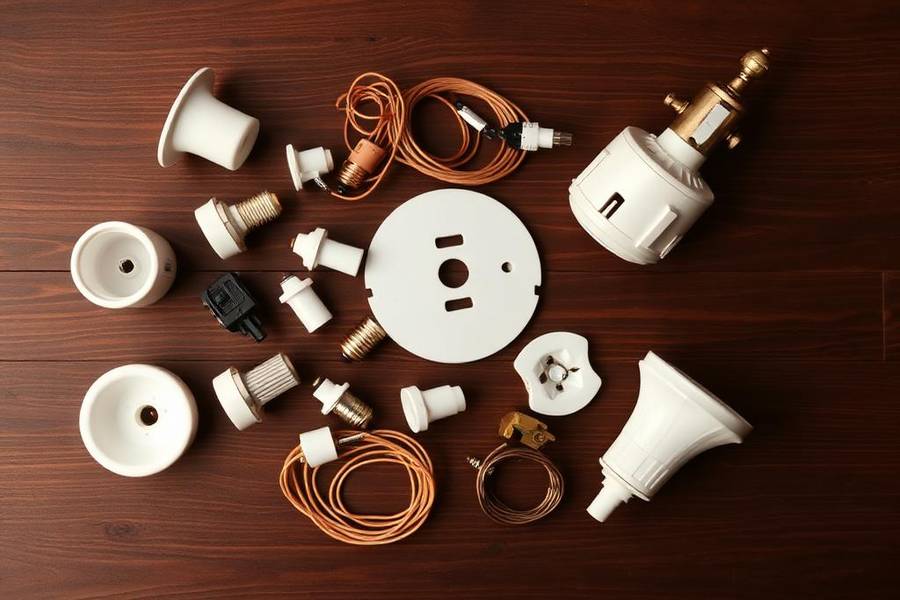
Lighting is one of the few household objects that combines electrical hardware, structural assembly, and decorative finish in a single piece. That is exactly why Antique Lamp Restoration Explained rewards a specialist rather than a generalist. At Vaughntero Co. in Peoria, every piece is opened, inspected, and evaluated as a whole system: the cord and plug, the socket shell and interior, the switch mechanism, the harp and finial, the shade fitting, and the base itself. A lamp that flickers may have a failing socket, but it may equally have a cracked strain relief, a loose neck, or brittle insulation hidden inside a hollow column.
Our technicians work from that full-system view. Instead of swapping one obvious part and sending the lamp back out, we resolve the underlying fault and then verify the whole assembly under load. That approach costs a little more time in the workshop and saves customers repeat visits, repeat charges, and the frustration of a repair that lasts a few weeks. It is also why so much of our work in Peoria arrives by referral from customers who were told elsewhere that their lamp was beyond help.
If you are unsure whether your piece is a candidate, call (623) 979-1532 and describe it. We will tell you honestly what is involved before you bring anything in.
Craftsmanship Details That Separate a Good Repair
Small choices decide how a repair ages. Wire runs should be routed so they cannot chafe against a threaded nipple edge. Underwriters knots belong inside the socket cap so tension never reaches the terminal screws. Conductors should be wrapped clockwise under the screw so tightening pulls the strand in rather than pushing it out. Strain relief must grip the jacket, not the conductors.
Polarity is not optional: the ribbed conductor lands on the silver screw and the shell, the smooth conductor on the brass screw and the center contact, so the threaded shell is never energized when the switch is off. We check this on every lamp regardless of how it was wired before, and a surprising number of factory and prior-repair jobs come to us reversed.
Finish work matters too. Felt bases are replaced when worn, so furniture is protected. Threads are cleaned rather than forced. Screws are matched in slot type and finish. These are the details customers cannot see and would notice immediately if they were skipped.
Serving Homes and Businesses Across the West Valley
Vaughntero Co. operates from Peoria and serves customers throughout Glendale, Phoenix, Surprise, Sun City, El Mirage, Avondale, Goodyear, Tolleson, Litchfield Park, and the surrounding Maricopa County communities. Residential customers make up the majority of our work, but we also support interior designers, antique dealers, estate managers, hotels, restaurants, salons, and property management companies with recurring fixture maintenance.
Arizona conditions influence what we see on the bench. Dry heat accelerates the embrittlement of older cord insulation. Dust from monsoon season works into switch mechanisms and socket interiors. Bright interior sun fades shades and softens adhesives. Homes with long seasonal vacancies come back to lamps that have sat unused and then fail on the first evening they are needed.
Knowing the local pattern makes diagnosis faster. Browse our areas served page for the full coverage map.
Safety Considerations Every Owner Should Know
Lamps are the most commonly overlooked electrical hazard in a home. They are moved, tugged, wrapped around furniture legs, run behind rugs, and left plugged in for decades. Insulation hardens with heat and age, copper strands break inside a jacket that still looks intact, and the failure often shows up as intermittent flicker long before it becomes a burning smell.
The warning signs worth acting on immediately are simple: warmth at the plug or socket, a scorch mark or brown halo at the outlet, crackling when the switch is operated, a bulb that loosens on its own, visible cracking in the cord jacket, or a lamp that trips a breaker or GFCI. Any of these should take the lamp out of service until it is inspected.
This matters even more with Antique Lamp Restoration Explained, where the components involved carry current continuously whenever the lamp is on. If you notice any of these signs in your Peoria home or business, unplug the lamp and call Vaughntero Co. at (623) 979-1532. Inspection is straightforward and inexpensive compared with the alternative.
Step-by-Step: What Happens to Your Lamp
First, intake and documentation. Second, visual inspection of the exterior, base felt, cord entry, and shade fittings. Third, electrical testing of the cord, plug, switch, and socket with the lamp both energized and isolated. Fourth, a written quote with options where more than one path is reasonable.
Fifth, disassembly with hardware kept in labeled order. Sixth, the repair itself: rewiring, socket and switch replacement, mechanical tightening, thread repair, cleaning, and finish work as approved. Seventh, reassembly with correct polarity, proper strain relief, and a secured underwriters knot.
Eighth, burn-in testing. We run the lamp, cycle the switch through every position, and check for heat at the plug, socket, and any control. Ninth, final cleaning and shade fitting so the piece leaves looking cared for. Tenth, handover, with a plain-language explanation of what failed and what to watch for. Read the expanded version on our process page.
Aftercare and Keeping the Repair Sound
A repaired lamp asks very little. Keep the cord out from under rugs and furniture legs, unplug by the plug body rather than pulling on the cord, and stay at or below the wattage marked on the socket. Dust the shade and base with a dry soft brush rather than a wet cloth, especially on paper, silk, and mica shades.
Once or twice a year, check the plug for warmth after an hour of use, confirm the neck has not loosened, and look at the point where the cord exits the base for any stiffening or hairline cracking. Two minutes of attention catches almost everything before it becomes a fault.
Our lamp maintenance checklist is a printable version of this routine, and our team is happy to walk any Peoria customer through it at pickup.
How Our Peoria Technicians Approach the Work
Every job begins with a written intake. We record the make and style where it is known, the age of the piece, the symptoms the owner has observed, and any sentimental or monetary value that should shape the repair strategy. That record travels with the lamp through the workshop so nothing is assumed and nothing is lost between benches.
Diagnosis follows. We test continuity through the cord, measure resistance across the switch, check the socket interior for arcing and carbon tracking, and inspect the plug blades for heat damage or looseness. Many faults that present identically to the owner have completely different causes, and guessing wastes money. Only after diagnosis do we quote. The quote lists parts, labor, and any optional upgrades such as a dimmer, a three-way socket, or a cloth-covered cord that better suits an older piece.
Once approved, work proceeds on the bench with the correct tools for the metal, glass, or ceramic involved. Finished lamps are burn-tested, polarity-checked, and wiped clean before pickup. Customers in Peoria and the surrounding West Valley are welcome to ask for photos of the interior work before collection.
Common Problems We Correct
The complaints that bring lamps to our bench repeat with remarkable consistency, and each has a specific cause. A lamp that works only when the cord is wiggled has a broken conductor or a failing strain relief. A lamp that hums or buzzes on a dimmer usually has an incompatible bulb or an undersized control. A lamp that flickers when a truck passes has a loose socket contact tab. A three-way lamp stuck on one brightness has a worn three-way socket, not a bad bulb.
Other frequent faults include stripped harp saddles that let the shade tilt, loose necks that allow the base to swivel and twist the internal wiring, corroded sockets in kitchens and bathrooms, cracked plastic sockets in lamps that ran high-wattage incandescent bulbs for years, and plugs that no longer grip an outlet.
Every one of these is repairable. Most are inexpensive. All of them are safer fixed than tolerated.
Antique and Vintage Considerations
Older lighting requires restraint. The correct outcome is a lamp that is electrically new inside and visually unchanged outside. That means preserving original patina rather than polishing it away, keeping original switches where they can be made safe, retaining maker marks and casting detail, and using reversible methods wherever possible so a future conservator has options.
We routinely handle brass and bronze bases, slag and stained glass shades, hand-painted ceramics, milk glass, mica and parchment shades, cast iron floor lamps, and mid-century pieces in walnut, teak, and enameled steel. Each material dictates a different cleaning method and a different adhesive or fastener strategy. Aggressive chemical cleaners and rotary polishing destroy value in minutes, which is why we test on hidden areas first.
Collectors and estate clients throughout Peoria and the wider Phoenix metro rely on Vaughntero Co. for exactly this discipline. Read more in our guide to caring for antique lamps.
Turnaround Times and Scheduling
Most standard repairs leave our Peoria workshop within two to five business days. Straightforward jobs are often completed the same day when parts are in stock and the schedule allows. Restoration work, custom fabrication, and pieces requiring specially sourced glass or hardware take longer, and we give a realistic date at intake rather than an optimistic one we cannot keep.
We understand that a lamp is often part of a room that feels unfinished without it. If timing matters for an event, a photo shoot, a staging deadline, or a hotel reopening, tell us at drop-off and we will tell you honestly whether the date is achievable. Commercial clients with multiple fixtures can arrange batched pickup and delivery so their spaces are never dark.
To check current turnaround for Antique Lamp Restoration Explained, call (623) 979-1532 or use the request form on this page.
The Value of Local, Accountable Service
Shipping a lamp to a distant restoration shop introduces the two risks owners fear most: damage in transit and a repair that cannot be discussed face to face. A local workshop removes both. You can see the piece on the bench, ask what a component does, and hold the shop accountable for its work in person.
Vaughntero Co. is based at 8471 W Jefferson St in Peoria, AZ 85345, and every repair carries our name. That accountability shapes how we quote, how we communicate delays, and how we handle the rare job that does not go as planned. It is a slower way to build a business and a far more durable one.
Call (623) 979-1532, email info@vaughnteroco.click, or visit our contact page for hours and directions.
Step-by-Step Guidance: Antique Lamp Restoration Explained
This section distils what our technicians actually do when working on antique lighting restoration. Read it before touching any lamp, and stop at the first step that feels beyond your comfort level.
1. Unplug and stage the work. Remove the bulb and shade, clear a padded surface, and photograph the lamp from several angles. Photographs are the cheapest insurance in any repair. 2. Inspect the obvious. Check the plug blades for heat marks, run the cord through your fingers to feel for stiffness or flat spots, and look at the point where the cord enters the base.
3. Test rather than assume. A multimeter set to continuity tells you in seconds whether the cord, switch, and socket are passing current. Most owners replace the wrong part because they skipped this step. 4. Open the socket properly. Press the shell where it is marked, separate the shell and insulator from the cap, and note how the conductors are terminated before disturbing anything.
5. Replace, do not patch. Fit a new UL-listed socket and fresh cordage rather than taping a damaged section. 6. Terminate correctly. Tie an underwriters knot inside the cap, land the ribbed conductor on the silver screw and the smooth conductor on the brass screw, and wrap each strand clockwise.
7. Reassemble and test. Confirm the shell snaps fully into the cap, seat the harp, refit the shade, and run the lamp for an hour while checking for heat at the plug and socket. Any warmth, buzzing, or flicker means the job is not finished.
If the piece is valuable, unusually constructed, or simply not cooperating, bring it to Vaughntero Co. at 8471 W Jefferson St in Peoria. Diagnosis is free and we will show you exactly what went wrong.
Where This Fits Into Professional Repair
Understanding antique lighting restoration makes you a better customer as well as a better DIYer. You will recognise a fair quote, ask sharper questions, and spot a shop that is replacing parts rather than diagnosing faults.
When you are ready for professional help, Vaughntero Co. handles this work daily for customers across Peoria, Glendale, Phoenix, Surprise, and the West Valley. Call (623) 979-1532 or request a free estimate.
Frequently Asked Questions
How do I know the repair worked?
Cycle the switch through every position, run the lamp for an hour, then check the plug and socket for heat. No warmth, no flicker, and smooth switch action means the job is sound.
Is it safe to keep using a flickering lamp?
No. Flicker usually means a loose contact or a broken conductor, and both generate heat. Unplug the lamp and have it inspected before using it again.
How often should lamps be checked?
Once a year for lamps in daily use, and any time you notice heat, buzzing, or a bulb that loosens by itself. Antique lamps deserve a professional check every few years.
Will a repair change the value of an antique?
A correct restoration preserves and often protects value. Aggressive polishing, replaced original hardware, and irreversible modifications are what damage it.
What tools are needed?
A basic kit covers most work: wire strippers, a multimeter for continuity, precision screwdrivers, needle-nose pliers, a socket wrench set, and a soft brush for cleaning.
Can I do this repair myself?
Some steps are reasonable for a careful DIYer, but anything involving live components, brittle insulation, or a valuable piece belongs on a professional bench. When in doubt, call Vaughntero Co. at (623) 979-1532.
Prefer to Leave It to a Professional?
Call Vaughntero Co. at (623) 979-1532 for a free estimate on any lamp repair, rewiring, or restoration project.